The Spain digital nomad visa is currently the most direct route for anyone already working remotely who wants to live legally in Europe. But almost nobody explains the part that changes everything: it is not one route, it is two, and one of them grants three years of residence instead of one. Here is what the law says, with the article beside every figure — and where we could not confirm something in an official source, we say so.
The short version, so you do not have to scroll. You must evidence €2,849 a month in 2026 (200% of the Spanish minimum wage), plus €1,068 for the first family member and €356 for each additional one. You need a university or vocational qualification, or three years of experience. Your relationship with the foreign company must be at least three months old, and the company must have existed for one year. Applied for at a consulate it lasts one year; applied for from inside Spain it lasts three. And you can invoice Spanish clients, but only up to 20% and only as a freelancer.
Spain digital nomad visa: what it is, and who the law actually lets in
The scheme is officially called international teleworking, and it was created by Law 28/2022, which added articles 74 bis to 74 quinquies to Law 14/2013. The legal definition is precise, and it is worth reading slowly, because almost every refusal comes out of it: a third-country national authorised to stay in Spain to carry out employed or professional work remotely, for companies based outside Spanish territory, using exclusively computer and telecommunications systems.
The word carrying the most weight there is outside. If the company paying you is in Spain, this is not your visa, however remote the work is. There is one exception, and only one, which we come to below.
The second filter is about your profile, and it rules out more people than you would expect. The law only admits qualified professionals: either you are a graduate or postgraduate of a university, vocational training institution or business school of recognised standing, or you evidence at least three years of professional experience. There is no official list of which universities count, which is why the experience route tends to be the safer one for anyone who studied outside Europe.
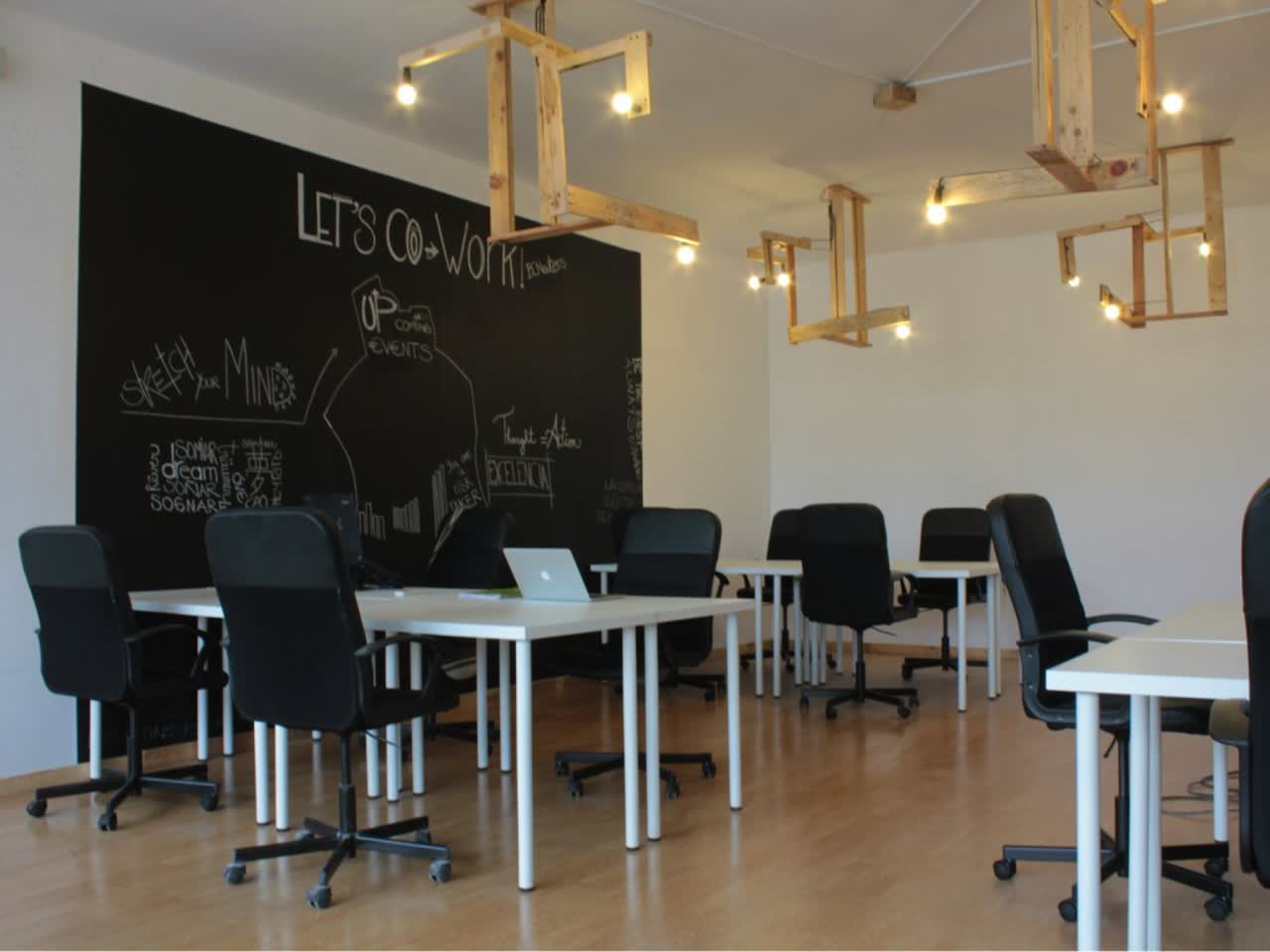
Coworking space in Barcelona. Photo © Gustavo Franco Cruz, Wikimedia Commons (CC BY-SA 4.0).
Spain digital nomad visa: there are two routes, and one gives three years instead of one
This is the part most articles blur, and in practice it decides how long you get to stay. The law provides for two separate permits, applied for in different places and lasting different lengths of time: the international teleworking visa, under article 74 quater, and the residence authorisation, under article 74 quinquies.
| |
Visa (consulate) |
Residence authorisation |
| Where you apply |
Spanish consulate in your country |
UGE-CE, online |
| Who can apply |
Anyone outside Spain |
Anyone already legally in Spain |
| Maximum duration |
1 year |
3 years |
| Renewal |
Converts into a residence authorisation |
2-year periods |
| Digital certificate |
Not needed |
Always |
| Legal basis |
Art. 74 quater, Law 14/2013 |
Art. 74 quinquies, Law 14/2013 |
The practical reading is simple. If you are in Brazil, Colombia or any country outside the European Union, the natural route is the consulate, and it gives you one year. But if you enter Spain as a tourist, within your 90 days, and while legally here you file the residence authorisation application, the permit you get lasts three years, renewable in two-year periods.
“Foreign nationals who are legally in Spain, or who entered under the visa provided for in the previous article, may apply for a residence authorisation (…) with a maximum validity of three years.” — art. 74 quinquies, Law 14/2013
There is an honest catch, and it is technical: the in-Spain route is fully electronic and requires a digital certificate, which in practice means you either have one or you need someone authorised to file on your behalf. The consular route does not have that problem. Neither is “better” in the abstract: it depends on where you are when you apply.
If you are still deciding between this and the other routes, we compare all five in our article on which visa to choose to live in Spain.
Spain digital nomad visa requirements: the four the law actually lists
Article 74 ter lists four requirements, on top of the general ones. They are drily worded, but each has a practical consequence worth anticipating.
| What the law requires |
What that means in practice |
| The company must have been genuinely trading for at least one year |
A company created recently just to hire you will not do. Proof of incorporation and trading is usually required. |
| Evidence that the work can be done remotely |
A letter from the company expressly authorising remote work from Spain. |
| An employment relationship with the foreign company for the last three months |
If you just changed jobs, you have to wait. This is the mistake that most often forces a restart. |
| If freelancing: a commercial relationship with one or more foreign companies for three months |
Contracts and issued invoices. Several clients count; you do not need a single one. |
Spain digital nomad visa income requirement: €2,849 a month in 2026
This is the figure everyone searches for, and the one most often quoted out of date online, because it changes every year. It is not a fixed amount in the law: it is a percentage of the Spanish minimum wage, which the Government revises annually. The main applicant must show 200% of the minimum wage, plus 75% for the first family member and 25% for each additional one.
For 2026, Royal Decree 126/2026 set the minimum wage at €1,221 a month over 14 payments, that is €17,094 a year. Spreading that across twelve months gives €1,424.50, and everything else is calculated from there.
| Who is coming |
Share of minimum wage |
Per month |
Per year |
| Main applicant only |
200% |
€2,849 |
€34,188 |
| Applicant + 1 family member |
275% |
€3,917 |
€47,008 |
| Applicant + 2 family members |
300% |
€4,274 |
€51,282 |
| Applicant + 3 family members |
325% |
€4,630 |
€55,556 |
These are rounded to the nearest euro. And one detail gets underestimated: the income must be recurring and demonstrable, not a one-off bank balance. Since the law already requires three months of relationship with the company or clients, the file will naturally include the payslips or invoices for that period, backed by bank statements.
Be careful with figures you find elsewhere. Any article written before February 2026 carries last year’s number, because the minimum wage rose 3.1% this year. If a source does not say which year’s minimum wage it used, the figure is worthless.
Can you work for Spanish companies on a digital nomad visa? Up to 20%, and only as a freelancer
Here is the exception promised above, and it is one of the worst-explained points. The law distinguishes between an employment relationship — an employee with a contract — and a professional relationship — a freelancer issuing invoices. And it treats them differently.
“Where an employed activity is carried out, the holder (…) may only work for companies based outside national territory. Where a professional activity is carried out, the holder shall be permitted (…) to work for a company located in Spain, provided that the share of such work does not exceed 20% of their total professional activity.” — art. 74 bis, Law 14/2013
In plain terms: if you are an employee, not a single euro may come from a Spanish company. If you are a freelancer, you may invoice Spanish clients as long as they stay under a fifth of your activity. For many project-based workers, that distinction decides how they should present themselves.
What the Spain digital nomad visa does not guarantee — and the positive silence rule
No serious article can promise you an approval, and we will not. Meeting every requirement is necessary but not sufficient: the authorities assess each file and may request further documents. Nor do we quote decision times, because they vary and we do not control them.
That said, there is one feature in the applicant’s favour worth knowing, because it is rare in Spanish immigration law. For authorisations under Law 14/2013, the Ministry’s electronic office states that, once the deadline has passed, the applicant may request a decision granting the permit by administrative silence. In other words, silence works for you rather than against you — the opposite of most immigration procedures.
On the fee: it is paid using form 790, code 038. A specific amount circulates online that we could not confirm in the official source, so we would rather not repeat it here. Check it on the form itself when you pay.
Where to live in Spain on a digital nomad visa
The visa does not tie you to any city: the residence authorisation is valid throughout Spain. In practice, remote workers cluster along the Mediterranean and in Madrid, through a mix of climate, flight connections and cost. Valencia and Malaga are the two reference points today; Alicante and Tarragona loom smaller in the imagination but usually work out considerably cheaper.

Valencia. Photo © chisloup, Wikimedia Commons (CC BY 3.0).
We compare climate, prices and neighbourhoods in our article on the best cities to live in Spain, and break down rent, utilities and groceries in how much it costs to live in Spain.
The hurdle after the Spain digital nomad visa: renting with no Spanish payslip
It is worth flagging because it catches almost everyone off guard: the visa solves your legal status, not your housing. And a Spanish landlord, faced with someone who has just arrived, with no Spanish payslip and no local payment history, tends to take the easy route and say no. You can clear the €2,849 comfortably and still collect four rejections in a row.
It is not a money problem, it is an evidence problem: the landlord has no way to verify your income. We gathered what usually unlocks those conversations in our article on how to rent in Spain without a payslip.
And if you want the full picture of moving over — visas, costs, cities, paperwork and your first days — it is all gathered in our guide on living in Spain.
That is exactly what a relocation advisory does: we guide you through the paperwork — what is missing, in what order, and where it usually stalls — and we solve the housing ourselves, with a contract in your name before you fly.
Frequently asked questions about the Spain digital nomad visa
How much do you need to earn for the Spain digital nomad visa in 2026?
In 2026 you must show 200% of the Spanish minimum wage, that is €2,849 a month (€34,188 a year). Add 75% of the minimum wage for the first family member, around €1,068 a month, and 25% for each additional one, around €356. The basis is the 2026 minimum wage, set at €17,094 a year by Royal Decree 126/2026.
How long does the Spain digital nomad visa last?
It depends where you apply. The visa applied for at the consulate in your home country has a maximum validity of one year (art. 74 quater, Law 14/2013). The residence authorisation, applied for while already legally in Spain, has a maximum validity of three years and renews in two-year periods (art. 74 quinquies).
Can I work for Spanish companies on the digital nomad visa?
If yours is an employment relationship, as an employee, no: you may only work for companies based outside Spain. If yours is a professional relationship, as a freelancer, you may work for a company located in Spain provided it does not exceed 20% of your total professional activity. This is set out in article 74 bis of Law 14/2013.
What qualifications do you need for the Spain digital nomad visa?
The law requires qualified professionals: either a degree or postgraduate qualification from a university, vocational training institution or business school of recognised standing, or at least three years of professional experience. You only need to meet one of the two routes, not both.
How long must you have worked for the company before applying?
At least three months of employment or commercial relationship with the company based outside Spain, immediately before filing the application. In addition, the company must have been genuinely and continuously trading for at least one year. This is set out in article 74 ter of Law 14/2013.
Does the Spain digital nomad visa allow you to bring family?
Yes, it covers a spouse or partner and children. You must show additional income: 75% of the minimum wage for the first family member and 25% for each subsequent one, on top of the €2,849 a month required of the main applicant in 2026.
Sources
This article is informational and does not replace legal advice. Euro figures depend on the minimum wage in force and are updated every year; requirements and paperwork may vary between consulates. Always confirm with the official source for your district. We do not promise that any visa will be granted, nor any decision times.